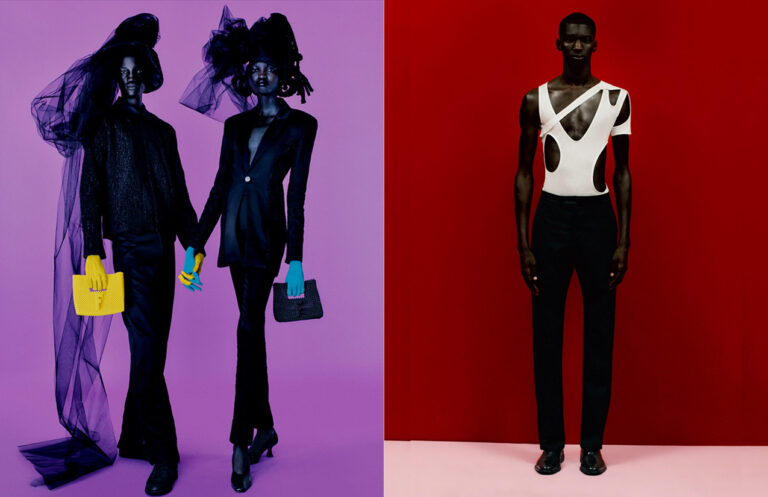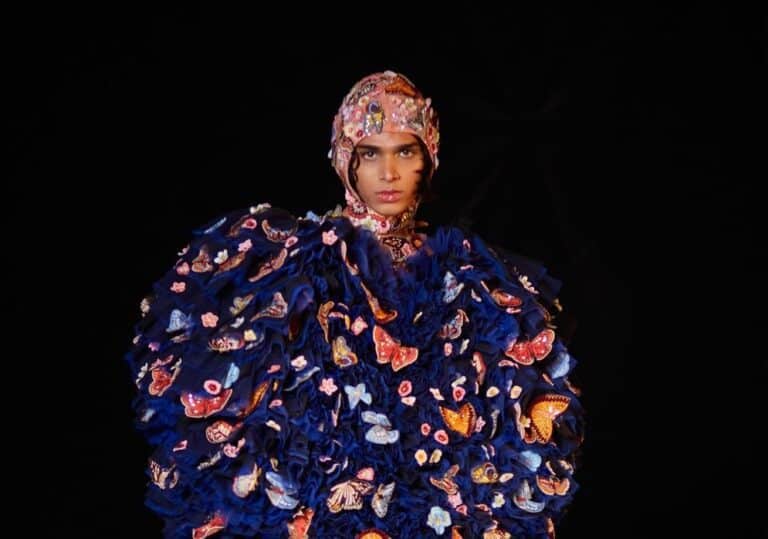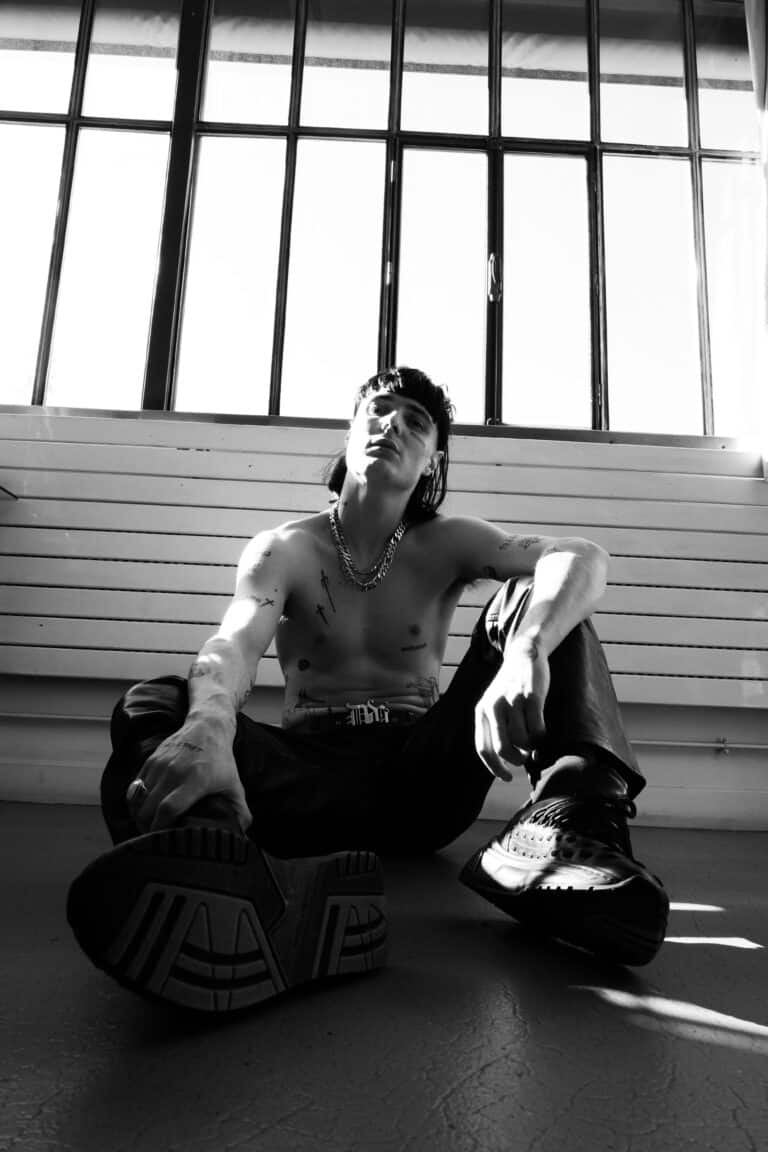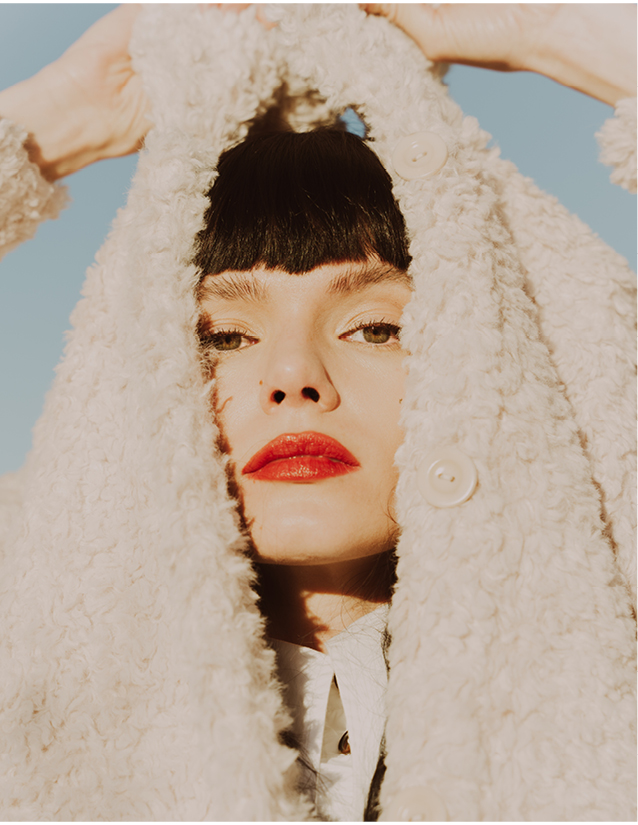
Bella and Gigi Hadid debuted with shaved heads at Marc Jacobs’ latest runway presentation in NYC

Read time 4 minutes

All clothing by Marc Jacobs.

In the face of a tumultuous world, Marc Jacobs’ AW22 collection serves as a vibrant call to take up space and embrace resilience. Through dramatic silhouettes and avant-garde materials, Jacobs creates fashion that challenges societal constraints and celebrates individuality.

Last season, Marc Jacobs’ vision of a post-atomic glamazonia had models in frayed monastic skirts, shredded column dresses, and hulking duvet jackets. The mood was grim, almost apocalyptic, with Bella Hadid, Gigi Hadid, and Anok Yai embodying statuesque figures, frozen in place as if a harsh wind had battered their bodies. Their poses exuded a sense of fatalism, drawing from the destructive forces of a world in chaos. Yet, as Jacobs returns to the runway for Autumn/Winter 2022, he offers a marked shift—one of optimism, color, and resistance against the pervasive pessimism surrounding us.

Marc Jacobs’ AW22 collection stands in stark contrast to the bleak palette and threatening silhouettes of last season. This time around, Jacobs swaps out muted, desolate tones for brighter hues, embracing a world of baby pinks, tranquil turquoises, serene lavenders, and refreshing limes. These lively colors inject a much-needed sense of optimism into the fashion landscape, representing a forward-looking view that defies the darkness of current events. Where his last collection felt wrapped in the melancholic fabric of a broken world, this collection celebrates life, hope, and the possibility of a better tomorrow.

Despite this shift towards brighter tones, Jacobs doesn’t abandon his signature aesthetic. The same built-up silhouettes return, enveloping the body in bulbous shapes and amorphous structures that dominate the wearer’s frame. Wrap-around sleeves and exaggerated bustles create a visual language of power, making a bold statement that rejects traditional norms of fashion and beauty. The garments are not merely clothes but sculptures, each piece commanding space and attention, almost as if daring the world to look away. While the shapes evoke a sense of battle-ready resilience, they also appear as a response to the fragile reality Jacobs recognizes in the world.

All clothing by Marc Jacobs.

The models for AW22 wear their looks with a sense of defiance, sporting harsh undercuts and towering Mary Jane platforms that push the boundaries of fashion’s typical femininity. These sharp, punk-inspired hairstyles paired with shoes that defy gravity transform the models into icons of strength and rebellion. In previous seasons, Jacobs’ designs have often flirted with softness and vulnerability; here, however, he shifts into a more confrontational tone. The towering platforms and severe cuts challenge the audience to consider not just the clothing, but the boldness and individualism of the wearer.

Jacobs quoted German philosopher Friedrich Nietzsche in an accompanying statement, saying, “We share our choices in contrast to the ongoing brutality and ugliness of a world beyond our insulated but not impermeable walls. We have art in order not to die of the truth.” This philosophical underpinning speaks volumes, framing fashion not just as an aesthetic pursuit, but as an act of survival. With the world teetering on the edge of political and social upheaval, Jacobs argues that fashion, as a form of art, is crucial to maintaining one’s sense of self amid the chaos. The collection becomes a powerful statement that fashion is not only a personal expression but a way to resist and persist in turbulent times.

The political climate during the development of AW22 was charged with tension, especially with the controversial reversal of Roe v. Wade and threats to other essential rights such as contraception and marriage equality. Jacobs’ collection can’t help but reflect this societal instability. The decision to embrace brighter colors and larger-than-life silhouettes feels like a direct counter to these regressive political forces, as if Jacobs is saying, “We will not shrink. We will not hide.” The collection serves as both a visual response to these challenges and a call for solidarity in the face of ongoing battles for freedom.

One of the most striking elements of the AW22 collection is Jacobs’ encouragement to “take up space.” From jumbo-stuffed sweaters to oversized gowns, every piece in the collection seems designed to force its wearer into a position of prominence, commanding attention and space in the world. This isn’t fashion made to fit into the background—it is fashion that asserts itself. In a society where many are told to minimize their presence, Jacobs makes a bold statement: we are here, and we will occupy every inch of the space around us.

The oversized sweaters in this collection are not mere clothing—they are objects of art. Jumbo-stuffed and tentacular, they add volume and intrigue, transforming the wearer into a sculptural figure. These garments serve as a visual metaphor for resilience and strength, rejecting the notion that fashion should ever be constricting or limiting. Instead, Jacobs’ pieces offer room to breathe, to move, and to exist on a larger scale, reinforcing the theme of taking up space in a world that often seeks to shrink individuality.

In true Marc Jacobs fashion, the collection also includes a selection of sequined ball gowns cut to exaggerated proportions that hark back to the avant-garde work of Rei Kawakubo. These gowns seem to be defying gravity and conventional beauty, shifting away from wearable couture towards a more conceptual interpretation of fashion. The enormous sequins and geometric shapes turn these dresses into moving sculptures, and in their formality, they make a statement about both defiance and elegance. Here, Jacobs leans into his ability to create fashion that goes beyond wearability, making garments that are not just clothing but works of art that challenge the status quo.

“Marc Jacobs’ AW22 collection is a vibrant celebration of resilience, embracing oversized silhouettes and lively colors to inspire confidence and individuality. His designs encourage us to stand tall, take up space, and move forward with optimism in an ever-changing world.”

All clothing by Marc Jacobs.

In the world of AW22, even the accessories refuse to follow traditional norms. The handbags in this collection are so oversized they could easily double as hammocks, further pushing the idea of excess and opulence. These bags symbolize a playful luxury, an invitation to indulge and embrace absurdity. They are not just functional items but bold statements in their own right, offering a sense of space and grandeur. Through these accessories, Jacobs taps into a sense of exaggerated extravagance, creating an ironic yet empowering commentary on consumerism and the freedom to go beyond the limits.

Jacobs’ exploration of materials also takes on a life of its own in AW22. Fabrics such as glass, paper, plaster, plastic, rubber, and denim transform everyday textures into something far more experimental. These diverse materials serve as metaphors for the fragmentation of our modern world—each one distinctive, yet capable of coming together to create something powerful and cohesive. By fusing unconventional materials, Jacobs reflects the complexity of our current reality, and in doing so, demonstrates how fashion can serve as both a commentary on and a coping mechanism for the world’s many contradictions.

One of the most interesting elements in Jacobs’ collection is his use of tinfoil hats, transformed from simple headscarves. This may seem like a whimsical nod to conspiracy theories, but it also reflects a broader cultural critique. The tinfoil hats evoke the increasing prevalence of conspiracy-driven ideologies, a subtle nod to the divisive political rhetoric that has dominated the internet. By incorporating these hats, Jacobs is pointing a finger at the cultural landscape, using fashion as a lens through which to explore how paranoia and distrust have seeped into the mainstream.

All clothing by Marc Jacobs.

The inclusion of wipe-clean, almost kinky Bo-Peep dresses adds yet another layer of intrigue to the collection. These dresses, which play with innocence and rebellion in equal measure, are a departure from the expected. Their playful yet provocative nature reflects Jacobs’ ability to turn convention on its head. Through this unexpected element, Jacobs reminds us that fashion, even in the midst of global upheaval, can still be playful, subversive, and liberating. These dresses offer a sense of whimsical escape from reality while still holding a deeper, almost cheeky, commentary on the societal constraints placed on women.

Jacobs’ AW22 collection straddles the line between art and reality, blurring these boundaries to make a statement about the role of fashion in contemporary culture. His designs go beyond mere aesthetics, carrying with them an inherent meaning that reflects the struggles and triumphs of the current moment. By pushing the boundaries of what fashion can be, Jacobs asks his audience to look deeper, to consider how these garments reflect both personal and collective experiences. In this way, the collection isn’t just about what’s on the runway; it’s about what those clothes represent in the broader context of the world.

At its core, Jacobs’ AW22 collection represents a form of political resistance. Each oversized garment, each playful accessory, and each provocative design sends a message that, despite the chaos of the outside world, fashion can still be a tool for personal empowerment. By embracing space, excess, and defiance, Jacobs creates a world where fashion isn’t about fitting in—it’s about standing out and asserting your right to exist on your own terms. In a time when rights are being questioned and voices are being silenced, Jacobs’ fashion refuses to shrink into the background.

All clothing by Marc Jacobs.

Jacobs’ collection invites us to think about the role of fashion in shaping cultural conversations. By drawing from art, philosophy, and political discourse, Jacobs shows how fashion can transcend its traditional role as mere clothing. His work is not just about fabric and silhouette—it’s about making a statement, starting a conversation, and offering a space for individuals to express themselves in a world that often tries to stifle those expressions. Jacobs invites us to use fashion as a means to engage, resist, and ultimately thrive in uncertain times.

As the world faces uncertainty, Marc Jacobs’ AW22 collection stands as a testament to the power of fashion as both resistance and hope. His designs remind us that, in the face of adversity, we have the power to create, to express, and to demand space. With his larger-than-life silhouettes, bright colors, and thought-provoking materials, Jacobs invites us to reclaim the world and our place within it—making a bold statement that, no matter how chaotic the world may be, we will continue to take up space.

Text by
Kyrie Carlo

Fashion by
Marc Jacobs

Posted
May 1, 2022

Text by
Kyrie Carlo

Fashion by
Marc Jacobs

August 9, 2018

Last season, Marc Jacobs’ vision of a post-atomic glamazonia had models whipped-up in frayed monastic skirts, shredded column dresses, and hulking duvet jackets. It was an austere and threatening outlook, with Bella, Gigi, and Anok standing statuesque, as if a wind had battered fabric against their bodies. But, as Jacobs returns to the runway for AW22, the designer appears to be looking towards a more positive future, swapping a washed-out colour palette for baby pinks, turquoises, lavenders, and limes. 

All clothing by Marc Jacobs.

The same built-up silhouette emerged, swamping the body in bulbous lumps and amorphous growths fashioned from wrap-around sleeves and bunched-up bustles, though it felt more embattled than nihilistic, with this season’s models in harsh undercuts and towering mary jane platforms. In an accompanying release, the designer quoted the German philosopher Friedrich Nietzsche, saying “we share our choices in contrast to the ongoing brutality and ugliness of a world beyond our insulated but not impermeable walls. We have art in order not to die of the truth.” It’s hard not to read this in relation to the recession of Roe v Wade and the threat the decision has posed on other hard-won rights, like contraception and gay marriage. 

All clothing by Marc Jacobs.

With Jacobs producing high-voltage fashion both despite, and in spite of, the news, the collection feels like a cue to take-up space. Sweaters were jumbo-stuffed and tenticular, sequined ball gowns were cut to Kawakubo-esque proportions, while handbags were so large they could probably double as a hammock. His fabrics ran the gamut of glass, paper, plaster, plastic, rubber, and denim, transforming headscarves into tinfoil hats – a nod perhaps to the conservative and conspiratorial internet thinking that has dominated mainstream politics – and wipe-clean, almost kinky Bo-Peep dresses. To see the rest of Jacobs’ AW22 collection, click through the gallery above.
Related

With to feel love/d, Luke James returns to R&B through a body...
From Ukraine to the world stage, Valentin Chmerkovskiy reflects on dance, discipline...
A new era in fashion, led by a wave of Black designers...
The natural setting of this “is where you can create and the...

Inside the world of Luke James as the artist traces desire, vulnerability and connection through his album

Read time 5 minutes

Text by
Kylar Ashton

Photography by
Ben Abarbanel.

Fashion by
Guvanch Agajumayev

Posted
June 19, 2022

Before *to feel love/d* entered the world, Luke James invited us into the quiet space where voice, memory and desire become music.

“This album is a culmination of experiences,” Luke says. “It is music that I’ve lived with for a while. I like to think of it as a bridge into my new endeavors as an independent artist.”

Following two years devoted to acting, to feel love/d marked Luke’s return to music on his own terms. Its first three singles—“go girl,” featuring BJ The Chicago Kid and Ro James, “all of your love” and “blow”—carried that return across major R&B playlists on Spotify and Amazon Music.

Luke’s history moves between the intimate and the iconic. He has written for Justin Bieber, Snoh Aalegra and Chris Brown, performed alongside Prince and opened for Beyoncé during The Mrs. Carter Show World Tour. His song “I Want You” earned his first Grammy nomination for Best R&B Performance, followed by a second nomination for “Options,” featuring Rick Ross, in the category of Best R&B Song.

With to feel love/d, that history becomes a threshold—the closing of one chapter and the first sound of whatever comes next.

Beyond music, Luke’s presence moves easily across the screen. In Lena Waithe’s The Chi, he entered a story shaped by life on Chicago’s South Side, where a single event sends tremors through a community and draws unexpected lives together.

His screen work also includes Universal Pictures’ Little, alongside Issa Rae, Regina Hall and Marsai Martin, and a leading role in Lee Daniels’s musical drama Star. Elsewhere, he has appeared in HBO’s Insecure, Unsolved: The Murders of Tupac and the Notorious B.I.G. and The Bobby Brown Story, portraying R&B singer Johnny Gill.

Montrose meets Luke at the intersection of music and performance, where he reflects on adrenaline, the philosophy guiding his life and the world taking shape beyond to feel love/d.

MONTROSE

Who is Luke James in five words?

LUKE

Loving. Honorable. Nasty. Happy. Sad. Okay, let’s see—what else is there?

MONTROSE

What is the first thing you do in the morning?

LUKE

I begin with a check—a self-diagnostic. I feel my body, my mind and my spirit. Then I express gratitude for waking up to another day. Thank you, God.

MONTROSE

What philosophy guides your life?

LUKE

“Don’t worry, be happy.” Not to sound cliché, but my mother always told me not to worry. I think I’m now at a place where I want to be. So yes—don’t worry, be happy. Everything is going to work out.

MONTROSE

What do people often misunderstand about you?

LUKE

I think people see me as an extrovert. Maybe I play the part well sometimes, but I’m naturally more introverted.

My career helps draw me out of that because I want to experience life in all its forms, and sometimes my instincts don’t allow me that pleasure. The work takes me outside of myself. It introduces me to people and new ideas. It keeps my mind open.

“With ‘to feel love/d,’ I aim to create a sonic journey where emotions flow freely, melodies captivate, and every listener finds solace in the music.” – Luke James

MONTROSE

What gives you the greatest adrenaline rush?

LUKE

The stage. It is a rush unlike anything else. I can come offstage having cut myself and not even realize it until the next day. In that moment, the adrenaline takes over.

MONTROSE

Where does your mind go when you are alone?

LUKE

A lot of places—some of them personal. I think about work, but not necessarily in the way everyone else might. I find pleasure in what I do, so when I speak about work, I am really speaking about my passions. They happen to make me money, which turns them into work—something I must continue doing to make a living.

But I enjoy it. So, to answer your question, I think about creativity. I think about God, love and the world. I try my best to think about things that make me happy.

MONTROSE

What quality do you most admire in yourself?

LUKE

My willpower. I am constantly reminded of how strong it is. If there is something I truly want, I work my ass off to get it.

It sometimes feels as though everything around me begins to shift, allowing me to reach whatever I am searching for. I am not pretending to be a guru—I am still figuring it out too.

MONTROSE

What might others find strange about you?

LUKE

I don’t know. Someone else might have to answer that. I don’t consider anything I do particularly strange. I’m interesting. Laughs.

MONTROSE

What three qualities do you value most in another person?

LUKE

Empathy, intellect and spirituality—something within that realm. There are so many qualities to value. Fucking three just isn’t enough.

MONTROSE

What struggle have you learned to move through?

LUKE

Seeing myself for who I am. Acknowledging it, honoring it and strengthening it. Learning to be happy with the process of becoming a better version of myself—and falling in love with that process.

It is constant. I believe it is a struggle almost everyone experiences.

MONTROSE

If you could leave your younger self one message, what would it be?

LUKE

Wake up early. Create, create, create. Stay open and be a sponge. Don’t worry.

Leave negative people and situations alone. Let them go. You may love them, but you can love them from a distance. Enjoy yourself. Be present in the moment, and listen to your own voice. Stay centered.

Many trying things will come your way. Be still and keep moving forward. Everything will be all right.

Yep, that’s it. I hope that made sense.

Photography by Ben Abarbanel. Styling by Guvanch Agajumayev. Grooming by Travis Lester. Casting by André Adkins.

Text by
Kylar Ashton

Posted
June 19, 2022

Text by
Kylar Ashton

Photography by
Ben Abarbanel.

Fashion by
Guvanch Agajumayev

September 7, 2026


Related

Make-up is dissident. It claims control over identity. It rewrites our biological...
Aimé Simone moves between shadow and light, transforming memory, desire and uncertainty...
Trevor Daniel returns to the person he was, tracing memory, transformation and...
Setting sail for 'Island of the Sun,' the artist weaves vulnerability, pop...

In the Loop

Make-up is dissident. It claims control over identity. It rewrites our biological...
Aimé Simone moves between shadow and light, transforming memory, desire and uncertainty...
Trevor Daniel returns to the person he was, tracing memory, transformation and...
Setting sail for 'Island of the Sun,' the artist weaves vulnerability, pop...